


How to improve Chemistry grades

Introduction
- Read the syllabus like a learning contract
- Break down past papers
- Know what the Examiners want from you
- Build a strong conceptual foundation
- Mechanistic understanding over Memorisation
- Integrate Mathematical lessons into Chemistry.
- Active Recall & Spaced Repetition
- Exam-Oriented Note making
- Parents matter more than you think in Chemistry success
- Understanding your child's curriculum pressure
- Establishing a healthy study routine
- Minimising emotional barriers to learning
- How can parents help without knowing chemistry?
Chemistry sits at the core of many modern fields that improving in it’s fabric lifts more than a grade, it opens doors. When a student dreams of medicine, engineering, environmental science, or any laboratory-driven career, chemistry can provide a conceptual scaffolding in fields with logic and understanding. Students are likely to struggle with any subject, and Chemistry particularly can be tricky making chemistry grades stand out, low grades leading them to dropping it for A-Level (which is both AS and A2). So how do you break the ice and help improve chemistry grades?
Summarised,
Cambridge and Edexcel curriculums are designed to build analytical thinking,to an unprepared student, it looks like a contraption they can fall into. Using Past papers, examiner reports, annotations, briefed writings, managed timings, and the help of their parents and teachers, students are able to improve chemistry grades with such strategic work actively and objectively configured by O/L, AS & A2 syllabuses for their exams.
Improvement in chemistry isn’t about memorisation, it’s mechanistic thinking.
Where O-Level focuses on breadth, making students gain exposure to a wide range of essential ideas.
AS (Advanced Subsidiary) helps students with the transitions from O-Level to A2.
A2 Chemistry focusing on depth and deeper understanding of additional material where only “10% of O-Level is in AS, and about 1-2% in A2” says Professor Imran Razeek, twenty years in teaching Cambridge and Edexcel syllabuses.
It’s more quality over quantity type work.
That’s the challenge.
So what are some tips and practices for strategic chemistry study?
Read the syllabus like a learning contract
Students often treat the syllabus like it is something the teacher handles behind the scenes, in reality, it’s the clearest window into what the examiners expect. Each topic is built around precise learning objectives broken down into commands such as “explain”, “describe” or “deduce”, indirectly asking “have you understood what you have been taught?”.
For instance, when you have been asked to “describe”, the examiner would expect clear factual statements.
“Explain” however, requires added reasoning, linking ideas together that shows understanding beyond memorisation.
Once students can make out what all these different command words actually ask them and taking a look at the marks allocated for each question, they can align their studying with what could be assessed.
The syllabus can be then used like a checklist tracking their progress and ticking off what they can do with confidence, it’s a more structured approach than simply “do everything”
By misunderstanding words, missing key notations, failing to structure their answer in a scientific manner, which is again, more preferred by the examiner, loses marks. This can result in that frustrating gap between what the student should write versus what they do.
Break down past papers
Different approaches to exam papers test different skill sets.
- In both Cambridge and Edexcel systems, the multiple-choice paper is the fastest paced. It requires sharp recall, intuitive understanding of trends, and the ability to rule out distractors quickly, this can help develop a skill at spotting patterns and common traps.
- A student who spends most of their time on theory but ignores practical visualisation is unlikely to find the joy in chemistry and may even think “What’s the point in all this theory?”. Cambridge and Edexcel academics and teachers make it an objective to have students do practical experiments which help give the visual process of how an element behaves. Instead of saying an element “reacts vigorously”, it’s more often than not better to see it happen.
- When practicing, you start with doing an exam paper with textbooks, notes or even
videos of lectures open.
– Read the question.
– Spend some time on its relevant topic.
– Answer it in your own words. - Then reading the exact answer to that question. The student can then tell if it requires additional steps, diagrams, the exact keywords necessary are. To basically optimize their marks by knowing the weight of each point and what is missing from their answer.
“At my institute this is what i encourage, read the question and then derive the answer by looking at the notes… even though it’s time consuming initially they will not forget as they are finding a solution for that specific question… Look at the mark scheme at the end” – Professor Razeek
Know what the Examiners want from you
If there is one resource students consistently under use, it is examiner reports. These short documents, often published after each exam series, pinpoint where previous students went wrong and are often given to study chemistry effectively.
They highlight recurring mistakes such as missing units in calculations, misinterpreting data tables, failing to use proper scientific terminology, or giving vague explanations where precise phrases were required. The examiner reports can provide a clear indication as to what the examiner perhaps is “thinking out loud”.
But pressure too gets to everyone, and clearly demonstrating knowledge becomes a hurdle, a hurdle examiners want you to clear.
Build a strong conceptual foundation
Every chemistry journey begins with a few core ideas. From a beginner level atomic structure, bonding, States of matter etc… These concepts show up again and again because they form the backbone of the entire subject.
Thinking Electrons spin in rings, mixing up “moles” with “molecules”, confusing energy with the speed of reaction, or assuming “equilibrium” means nothing is happening.
Individually these misconceptions aren’t so bad, together, they trip students across papers.
Mechanistic understanding over Memorisation
Instead of learning definitions by heart, it helps to picture how atoms interact, how energy changes, and why reactions occur & behave the way they do. Simply sketching particle diagrams or energy profiles can turn an abstract idea into something visual and intuitive.
Then you may tend to want to draw different ideas that are new to you to give yourself an understanding that is more than words.
It’s this kind of “how it works” or “how it could work” thinking that may makes it not so overwhelming but logical and interesting.
Integrate Mathematical lessons into Chemistry.
Mathematics is woven into chemistry gently, unlike physics. Rearranging equations, insufficient decimal places causing inaccuracy, units conversion etc… Could make the most problems if gone wrong, for example: grams (g) and milligrams (mg) in chemistry this could mean the difference between the sky and the earth, you are either dealing with the most volatile substance or the most chemically inert elements.
Changing a value just because it doesn’t look harmful doesn’t mean there is no repercussions.
A more subjective approach would be trying to make sense of dimensional analysis (making sure the units aren’t crazy) can often catch mistakes.
At A-Level, logarithms appear in topics like pH, but they’re really just another way of expressing chemical behaviour.
What matters most is handling questions that require multiple steps with a calm approach and working each line instead of rushing to the final answer.
Active Recall & Spaced Repetition
Testing your memory repeatedly is one of the most effective ways to learn chemistry instead of rereading textbooks.
Flashcards are perfect for this, but only when used correctly. Students should answer the cards before turning them instead of speed running them. Mark the ones you got wrong so the cards appear more often. Then pair this with spaced repetition, reviewing the same content over increasing intervals, such as a few days, then a week, then two weeks, and so on.
Another trick is interleaving: mixing different topics together rather than studying them in neat chapters. There is a bit of discomfort, but that’s good, it mirrors the way some exams are structured.
Jumping between ideas making students more flexible.
Exam-Oriented Note making
It’s like organising them in a can for consumption.
The Cornell-Note taking method, for example, helps students break topics into summaries, key ideas and self testing questions. It’s one of many concise, clear, and clever method to improve chemistry grades.
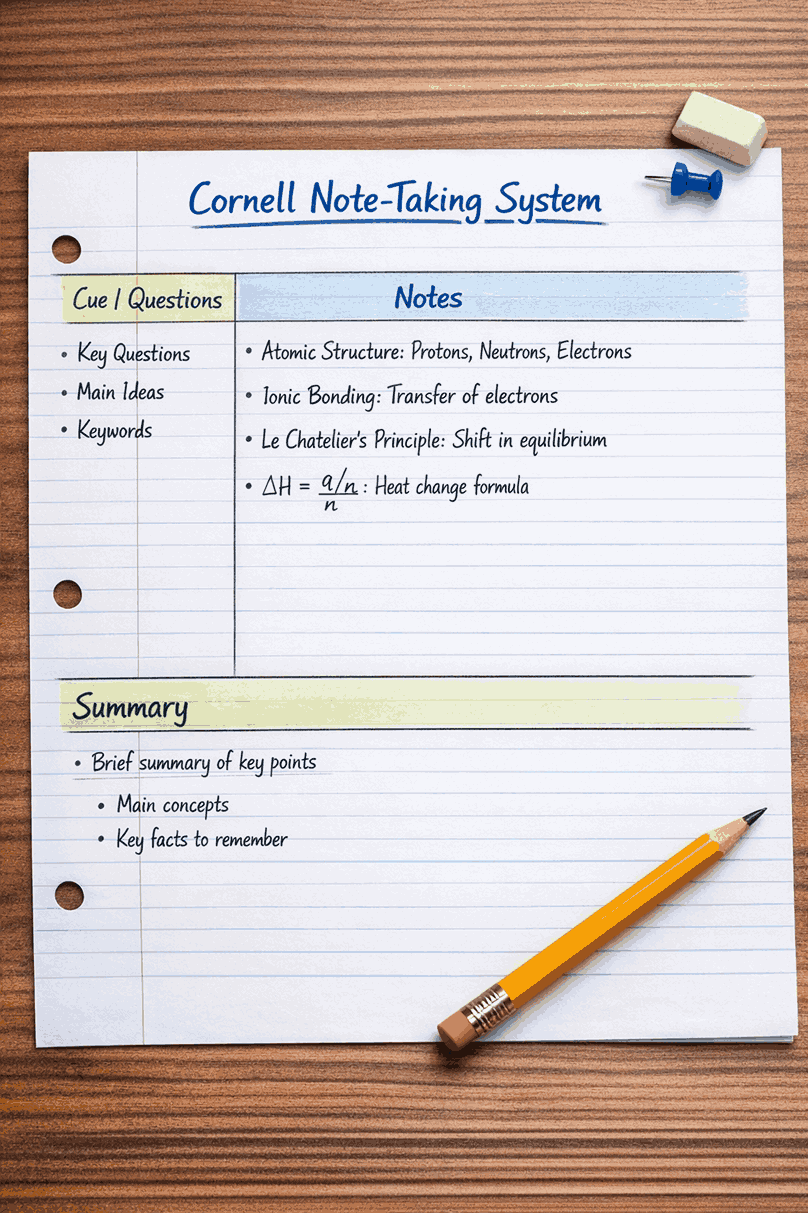
For dense theory like bonding, energetics, or organic chemistry, the Cornell-Note Taking method fits like a glove. For other topics that require a clear comparison, such as Ionic Versus Covalent Bonding, or the most reactive elements Versus the most nonreactive elements, a double column table works just as good by differentiating them beautifully.
When it comes to calculations, an equation sheet is one way to lay out all the equations you would need.
Having all formulas in one place stops you from wondering, “what was the formula for this question?”. Additionally, having the formulas in each Cornell-note sheet potentially makes it easier to deduce which topic it’s from.
Parents matter more than you think in Chemistry success
Exams become the source of pressure, students feel the gravity go up. But it’s a feeling, something that can change simply by parents understanding better and lightening the load, or it can shoot the other way.
Parents often worry that they can’t support their child’s chemistry learning simply because they don’t remember the subject themselves. But the best academic support is outside of teaching content. It comes from shaping habits and attitudes the parts of learning teachers don’t teach.
Understanding your child’s curriculum pressure
From O-Level to A-Level the cognitive load jumps sharply, students move from recalling information to applying, analysing and evaluating it under time pressure. Some parents believe that “studying more means scoring more.” But students don’t just need longer hours they need smarter support. They may feel lazy or get distracted, it’s only normal.
As a parent, lifting that laziness and removing that distraction can be good, but it’s the way you do it. Perhaps not policing your child, just merely speak to them about things that are maybe even irrelevant to the subject but something meaningful, use that time to connect with your child. Then the attention is on you, instead of the phone.
Another important factor is where your child’s attention is. When they are lazy, they think “tomorrow I’ll start”, “tomorrow i can do it”, help them change that “tomorrow” to “today”.
Then the work tends to happen.
If it doesn’t work, don’t force. They may not want to do it anymore.
You could ask them to “pick one question to try”, or “Imagine finishing this and having the rest
of the evening free”.
When they are lazy or distracted, they more often turn toward technology, bring in a tennis ball, play some catch. Distractions are in varieties and some can make their thoughts ecstatic, violent or even calm.
Cambridge or Edexcel curriculum are designed to make students think differently. Longer hours constitute fatigue.
Establishing a healthy study routine
Starting with realistic expectations. Students can’t perform at their best if their day is packed without a few hours to relax themselves. Breaks aren’t supposed to be a luxury, they’re part of effective learning.
Short pauses can help reset the brain, and perhaps make study time more efficient. Encourage more balance like this rather than burnout, students begin to see their work as manageable rather than overwhelming, protecting your child’s well-being.
Minimising emotional barriers to learning
Science subjects, especially Chemistry and Physics, often trigger anxiety in students who worry they’re “not smart enough.” Parents can help dismantle that fear, or add more.
Rewarding effort, progress, and small wins can turn a stressful subject into a challenge worth attempting. This growing mindset has more to it, a belief in your child’s ability to improve with practice sprouts when parents choose to reward steady effort instead of chasing perfection.
Avoiding comparisons with “that other child” is perhaps another way to preserve your child’s
confidence.
Every student learns at a different pace, this could derail learning faster by making them feel
inadequate.
How can parents help without knowing chemistry?
You don’t need to explain electrolysis or balancing formulas to make a real difference. What can help is steering your child toward thinking about how they learn.
Simple metacognitive questions:
“Did you understand today’s lesson better than yesterday?”
“What part felt hardest when you tried it on your own?”
“What’s your plan for fixing the tricky bits?”
Checking consistency rather than correctness is another underrated form of support. Even the best students make mistakes. What matters is whether they follow a routine: notes reviewed, questions attempted, errors reflected on.
Strong performance in chemistry is not the effort of just the student, or teacher, or place of learning. There is a collaboration, an alignment of student discipline, parental support, and effective teaching and so on.
“Success is a guided process” – Imran Razeek, Professor at Chembase